From Garamond to San Francisco: The Story of Apple's Typography
Few brands have shaped modern typography the way Apple has. From the colorful rainbow logo of the 1970s to the sleek minimalism of today, every typeface Apple has used was chosen for a specific reason — and most of those reasons say more about the company's strategy than its aesthetics.
This is the story of how Apple's typography evolved across five decades, why the company eventually decided to commission its own typeface, and what designers can learn from the way one of the world's most valuable brands thinks about type. (For the broader context on how brand typography has evolved across the industry, see our guide to the evolution of brand typography.)
1977 to 1984: Motter Tektura and the Rainbow Years
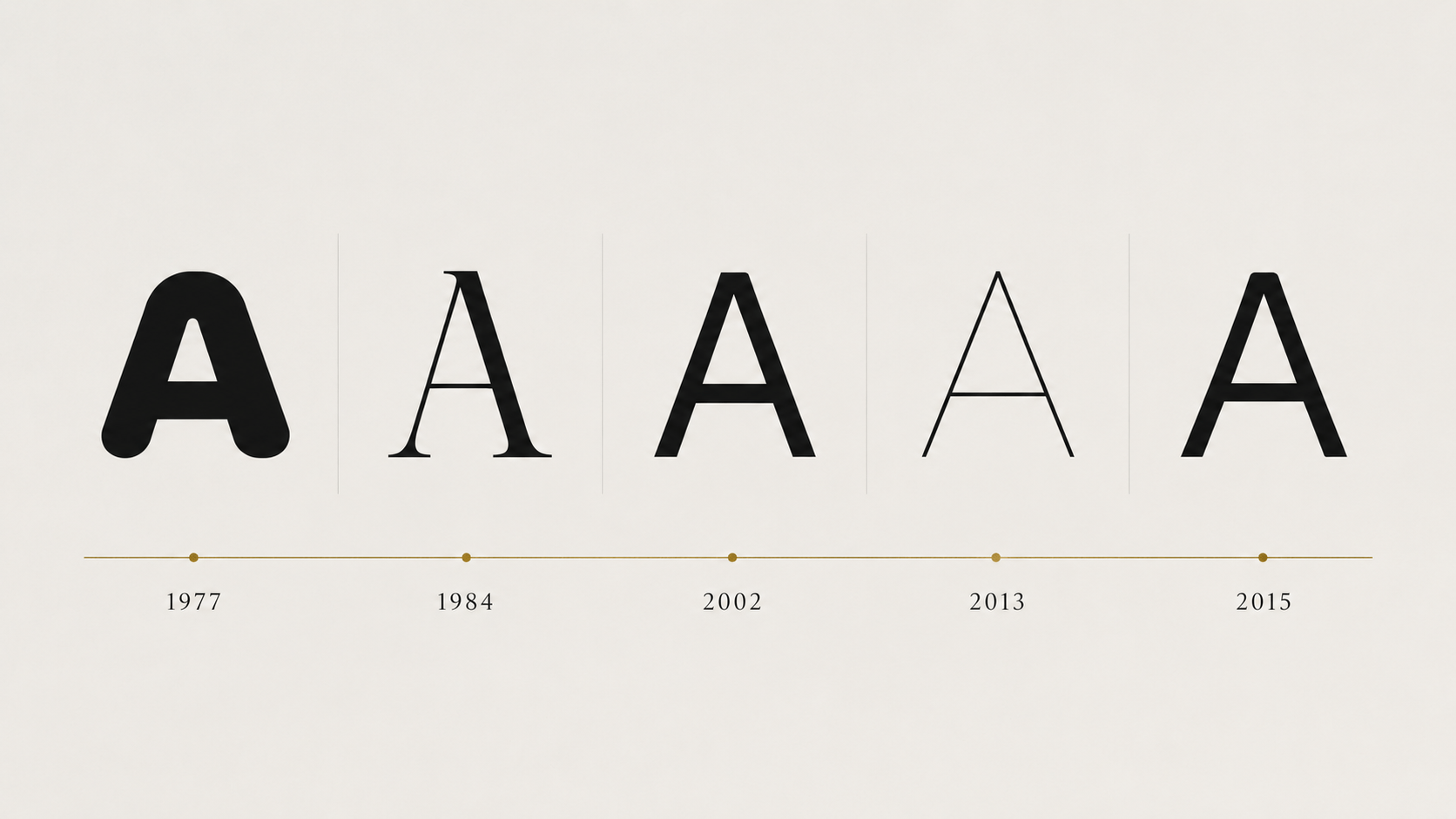
The wordmark on the original 1977 Apple Computer logo — the famous rainbow apple with a bite taken out — used a typeface called Motter Tektura, designed by Othmar Motter in 1975. It was a quirky, slightly futuristic display font with rounded terminals and a distinctly mid-1970s personality.
Tektura was never a famous typeface in itself. It became famous because Apple chose it. Designer Rob Janoff selected it specifically for the rainbow apple logo because the rounded letterforms echoed the curves of the apple shape — visual harmony that made the wordmark feel like part of the symbol, not separate from it.
This early decision set a pattern Apple would repeat throughout its typographic history: typefaces serve the design, not the other way around.
1984 to 2002: Apple Garamond Defines an Era
When Apple repositioned itself in the early 1980s as a more refined, design-led company, the playful Tektura no longer fit. The replacement, introduced around the launch of the original Macintosh in 1984, was a custom variant of ITC Garamond condensed by 80 percent — known internally as Apple Garamond.
The choice was deliberate. Garamond is one of the oldest and most respected serif typefaces in Western typography, with roots in 16th-century French type design. By choosing a Garamond variant, Apple was associating itself with centuries of typographic heritage — a counter-positioning move against IBM's monolithic, sans-serif corporate identity. Where IBM said "we are the future of business," Apple Garamond said "we are the inheritors of craft."
Apple Garamond appeared on packaging, manuals, advertising, and product wordmarks for nearly two decades. It defined the look of the company through some of its most iconic moments — the launch of the Mac, the "Think Different" campaign, the introduction of the iMac in 1998. By the time Apple retired it in the early 2000s, it had become one of the most recognizable corporate typefaces in the world.
2002 to 2013: Myriad Pro and the Industrial Era
The next shift came alongside Apple's transformation from a struggling computer company into a global consumer electronics powerhouse. As products got more refined — the iPod, the iPhone, the unibody MacBook — Apple's typography needed to feel less like a publishing house and more like a hardware manufacturer.
The replacement was Myriad Pro, a humanist sans serif designed by Robert Slimbach and Carol Twombly for Adobe in 1992. Apple commissioned a slightly modified version called Myriad Apple, then later switched to the standard Myriad Pro for marketing and product packaging.
The shift from a serif to a sans serif was significant. Serifs carry connotations of tradition, literature, and craft. Sans serifs feel modern, technical, and clean. Apple's move to Myriad mirrored its repositioning from a creative-professionals brand to a mass-market consumer technology brand. The typography didn't lead that change — it followed it. But it made the change visible at every customer touchpoint.
2013 to 2015: The Helvetica Neue Interlude
When iOS 7 launched in 2013 with its radical visual overhaul, Apple introduced Helvetica Neue Ultra Light as the system font on iPhones and iPads. This was Apple's most controversial typographic choice in years.
The thin weights of Helvetica Neue looked elegant in marketing materials and on the high-resolution Retina displays of newer devices. But on small screens at small sizes — text messages, app labels, settings menus — the ultra-light weights were genuinely difficult to read. Accessibility experts pointed out that legibility had been sacrificed for aesthetics.
The criticism was loud enough that Apple walked it back. By 2014, the system was already shifting toward heavier weights of Helvetica Neue. By 2015, Apple was about to do something it had never done at this scale before: design its own typeface from scratch.
2015 to Today: San Francisco and the Custom Typeface Era
The release of the Apple Watch in 2015 created a problem no off-the-shelf typeface could solve. Smart watch faces are tiny, the typography needs to read at a glance, and the interface design language Apple wanted simply didn't exist in any commercial type library.
The solution was San Francisco, designed by Apple's in-house type team. It debuted on the Watch and quickly expanded across iOS, macOS, watchOS, and tvOS. Today, San Francisco is the system typeface for every Apple operating system, with multiple optical sizes, two main families (SF Pro and SF Compact), and dynamic adjustments that respond to context — heavier weights at small sizes, more open letterforms in low-light displays.
San Francisco is a humanist sans serif in the same broad family as Helvetica and Akzidenz Grotesk, but with proportions and details specifically tuned for screen rendering at every size from 9-point captions to billboard-sized marketing typography. It's the most ambitious typographic project any consumer technology company has ever undertaken, and it's available for free to developers building on Apple platforms.
Why Apple Built Its Own Typeface
The decision to commission a custom typeface wasn't just about aesthetics. There were three strategic reasons.
Legal protection. A proprietary typeface can't be downloaded, copied, or reused by competitors. It's a permanent visual asset that strengthens brand identity over time. (This is the strategic distinction at the heart of logo fonts versus brand fonts — a custom typeface gives a brand control over both at the same time.)
Technical control. Apple's products span screens from the Apple Watch to the Pro Display XDR. A typeface designed by Apple, for Apple's hardware, can be optimized for every one of those rendering environments in ways an off-the-shelf font cannot.
Cost over time. Licensing a typeface for global use across hundreds of millions of devices is expensive. Designing one once and owning it outright is, at Apple's scale, dramatically cheaper.
The decision matched a broader trend: Google commissioned Product Sans for its 2015 logo redesign, Netflix commissioned Netflix Sans in 2018, Airbnb developed Cereal in 2018. The largest brands in the world have moved away from licensing existing typefaces and toward owning their typography outright. Apple was one of the first to make the leap at this scale, and its success has shaped how every major brand approaches type today.
What Designers Can Learn From Apple's Typography
Five decades of typographic decisions add up to a few clear lessons that apply far beyond Apple itself.
1. Type follows strategy, not the other way around. Each of Apple's font changes mirrored a broader shift in what the company was trying to be. The typography didn't drive the change, but it made the change visible to every customer.
2. Custom doesn't always mean drawn from scratch. Apple Garamond was a condensed variant of an existing typeface. Myriad Apple was a slight modification of a commercial font. The custom San Francisco is the exception, not the rule. Most brands that "custom-design" their typography are actually customizing existing typefaces — and that's still a defensible approach.
3. Legibility wins arguments about aesthetics. The Helvetica Neue Ultra Light era is the cautionary tale. Apple knows its design history, and the team learned from that mistake when designing San Francisco's optical sizes.
4. The right typeface for a brand is the one that fits the medium. Apple Garamond fit print catalogues. Myriad fit packaging and marketing. San Francisco fits screens. Each typeface was chosen for the dominant medium of its era. As the medium changed, so did the typography.
If your brand is going through a similar shift — from print to digital, from desktop to mobile, from one product category to another — Apple's typographic history is a five-decade case study in how to make those transitions visible, deliberate, and well-considered. The font you choose says more about your brand than almost any other design decision. It's worth choosing it carefully.