
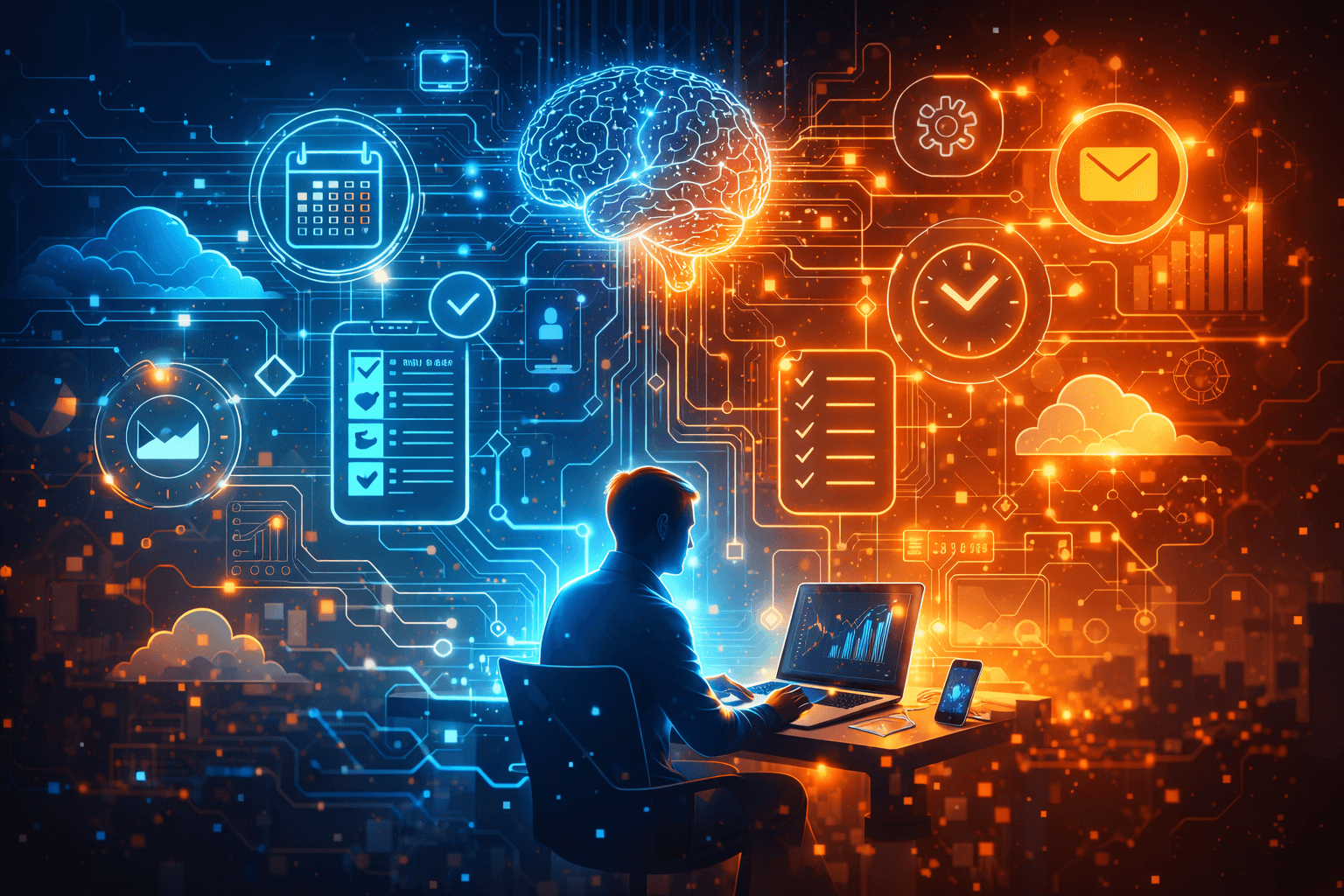
Previously, productivity was a highly individual issue. You got up, made a schedule, and had to depend on self-discipline to survive the day. You put the blame on yourself in case of failure. In case you got it, you attributed it to willpower. However, somewhere in the middle of it, technology silently redefined the rules.
Nowadays, productivity is not only a matter of effort. It is concerning systems, patterns, and habits that are shaped by the digital tools that we have to utilize on a daily basis. I have personally experienced this change. My productivity can no longer be determined by my motivation, anymore, but rather by how well I have designed my digital habits.
Technology is no longer an assistant. It has now become an active way of our working, thinking, concentrating, and even sleeping. And when you begin to observe this change, you cannot undo it.
The Digital Tools to Digital Habits Evolution
Initially, digital tools were one-dimensional tools. Paper planners have been substituted with calendars. Notebooks were substituted by note-taking apps. Email replaced letters. These instruments were lurking in our action.
Modern tools don’t wait. They are timely, remind, propose, and even make decisions on our behalf.
Having to start your morning day after day, opening the same task manager without considering it, it is no longer a tool; it is a habit. Behavior design at work, when your calendar blocks focus time automatically. With time, repetition transforms digital interactions into routine, and routine becomes habitual without much thought.
This is the reason why productivity no longer seems to be self-control but a system design. Not only do the tools that we have ensure productivity, but they also train it.
The Reason Productivity No Longer Means Working Harder
The productivity discourse was based on hustle over the years. Wake up earlier. Push harder. Do more. Such an attitude does not live in the world of constant alerts, endless emails, and information overload. The harder one works, the more burnout will occur.
The key is working smarter in the modern work environment, and technology has been leading this change. The most useful tools make our brain not think about repetitive decisions as they are done on our behalf. They can sort out data, automatic reminders, and bring some order to where there was a mess.
Your system already knows what you should do next, instead of you asking, what should I do next? This psychological liberation is among the largest, but least recognized, output benefits of the digital era.
The Way Technology is Altering Behavior Without You Noticing
It is one of the strongest aspects of modern productivity tools since they are so subtle. They don’t demand change. They nudge it.
Frequency is stimulated by a reminder. Motivation occurs in the form of a progress bar. A streak builds commitment. All this is not obtrusive, but it does affect behavior.
It is common across behavioral researchers to mention that the environment, rather than motivation, influences habits. We are in the age of digital tools. They plan default actions, alleviate friction, and direct attention.
High productivity can be achieved with the help of a properly designed environment without additional efforts.
The Emerging AI in Personal Productivity
Artificial intelligence has changed the tools into active partners. Rather than receiving instructions, AI-driven platforms achieve learning behavior, foresee needs, and give recommendations before things go wrong.
Cybernews states that a significant number of professionals have turned to top AI personal assistant technologies to simplify the work process, coordinate a schedule, and avoid the overload of the mind when performing their daily tasks. They not only assist the users to remain organized, but they are also evolving and adjusting to personal work styles, which makes it more personal and sustainable in terms of productivity.
This transformation is significant in the sense that it alters the relationship with work. The productivity ceases to be an everyday battle and becomes a process in the background.
Personalization: The Lost Half of Old Productivity
The first reason why certain traditional productivity advice fails is that it is consistent and does not differentiate people.
Other individuals perform optimally during the morning. Others peak late at night. Some thrive with structure. Others need flexibility. It is this diversification that is finally considered by digital productivity tools.
Contemporary systems are behavioral learners. They get used to the length of time that activities really take, which distractions occur most frequently, and which periods the concentration naturally decreases.
In the long term, this will build a less forceful workflow that is more intuitive. Technology does not make you fight with your nature but works with it.
The Online Habits That Do Help You Be More Focused
All digital habits are positive. Others develop a diversion rather than clarity. However, when applied deliberately, technology can significantly enhance concentration.
Scheduling is one of such habits. Electronic diaries that facilitate time blocking allow transforming intentions into tangible commitments. It becomes powerless when procrastination is given a timeline.
Task consolidation is another formidable habit. Workflow tools where similar tasks are bundled together minimize mental switching, enabling deeper concentration and quicker performance.
Closing open loops quickly belongs in the same category. A document left unsigned for a week takes up far more attention than the two minutes it would take to deal with, which is why more teams now send contracts for electronic signature rather than printing, scanning, and chasing. The point is not the tool itself; it is that a loop stops draining focus the moment it is closed.
Control of notification is probably the least appreciated habit. Disabling unneeded alarms is not a method but a way of thinking. Gradually, you stop being impulsive and begin to make a selection. Such habits do not require discipline. They remove friction.
Psychological Effect of Digital Productivity Systems
The notion of productivity is very psychological. Badly constructed systems amount to stress, guilt, and pressure. Properly designed ones bring sanity and serenity.
The brain relaxes when the activities become externalized in a reliable system. You do not need to keep everything in mind anymore. The system remembers for you.
According to a former author, Cal Newport, lack of clarity about what counts kills the anxiety about what does not. The use of digital tools that are not overly complicated facilitates not only productivity but also good mental health.
That is why minimalism in productivity systems can be very successful in comparison with feature-heavy platforms.
Productivity Tools Work Against You When They Do Not
It is worthy to note that technology might also be counterproductive. In cases where tools become complex, productivity becomes busy work. Switching apps all the time, too much tracking, and the ability to customize everything may eat up energy rather than conserve it.
When you end up consuming more time working on your productivity system than on real work, the system is not working.
It is not aimed at maximizing everything. It is to aid development without requiring any focus.
Final Thoughts
Technology has not merely modified the way we work but has modified even the way productivity works. It is not the tools that have transformed; it is the habits formed by the tools.
When technology is used to fit human behavior, productivity is sustainable rather than depleting. You give up pushing and begin riding along.
The most effective productivity mechanisms do not require attention. Day, day, day, they quietly go along with your objectives. And once you have had that type of productivity, you can never go back.
