
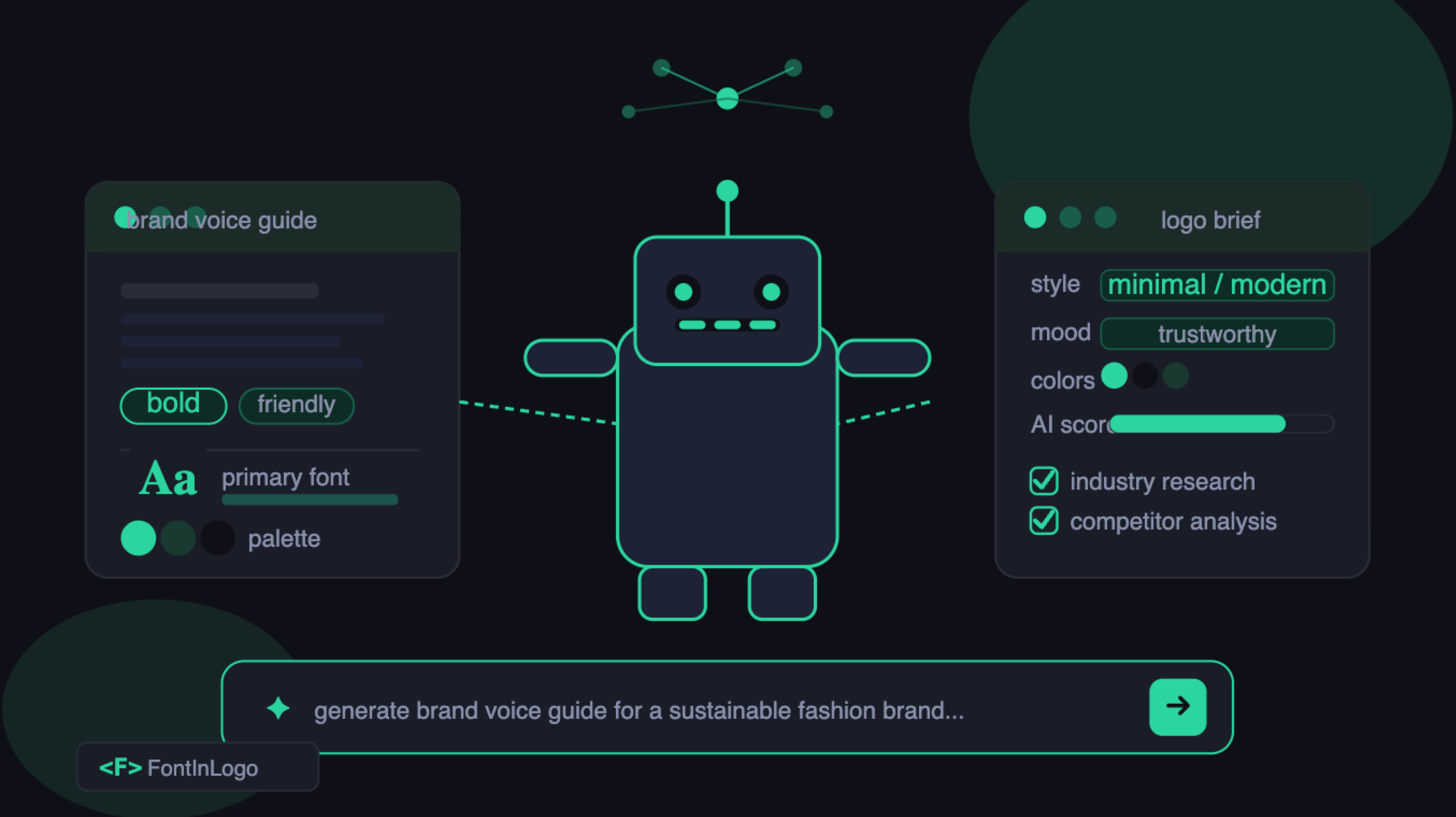
Most designers didn't get into this work because they love writing. They got into it because they love making things look good. But somewhere between the first client call and the final logo delivery, every brand project demands a pile of documents that have nothing to do with visual craft: brand voice guidelines, creative briefs, tagline options, tone rationale, naming shortlists.
Those documents used to take up a disproportionate share of a project's timeline. Designers would either rush them, outsource them to a copywriter, or leave them out entirely and hope the client wouldn't notice.
That whole situation has shifted in the last year.
- Brand voice documents that used to take a full day now draft in under an hour
- Creative brief templates are getting populated in real time during discovery calls
- Naming exercises that produced 30 mediocre options now produce 300 options worth filtering
- Designers who used to dread the writing portion of branding work are starting to enjoy it
This piece covers how designers are using AI for the written layer of brand work, what's actually improving in output quality, and where the technology still falls short enough that you shouldn't trust it.
The Written Side of Branding Nobody Talks About
When people think of branding, they picture logos, color palettes, and typography. Those are the deliverables clients frame and share. The written deliverables (voice guides, messaging frameworks, naming rationale) are the ones that actually keep a brand consistent after the designer walks away.
A brand voice document tells the client's marketing team how to write a tweet versus a legal disclaimer without losing the thread of who the brand is. A creative brief tells the next designer or agency what the brand is trying to be and what to avoid. A messaging framework tells the product team how to describe features in a way that sounds like the brand rather than a generic SaaS startup.
These documents matter. They also take hours to write well, and most designers were never trained to write them.
Using AI to Draft Brand Voice Guidelines
This is the highest-leverage use case for AI in branding work right now.
A brand voice document typically covers the brand's personality traits, its tone in different contexts, its vocabulary choices (what it says and what it avoids), and examples of the voice applied to real scenarios. Done properly, it runs 8 to 15 pages.
The workflow that's emerging among branding designers:
- Feed the AI the discovery call notes or client questionnaire responses. The rawer the better. Transcripts work well.
- Ask for a first draft of the voice document. Specify the structure, the length, and the audience who'll be reading it.
- Review and sharpen. The AI will produce something usable but often generic. Your job is to add the specificity that makes it the client's brand rather than any brand.
- Generate scenario examples. This is the section clients find most useful. Have the AI write sample social posts, customer service replies, product announcements, and error messages in the brand voice you just defined.
Designers who work with an AI chat tool that holds long context have a noticeable advantage here, because the voice document and the scenario examples need to stay consistent across what can be dozens of separate generations. Losing context halfway through a brand voice project means restarting your prompting from scratch.
The time savings on this single document type are usually the first thing designers notice. A voice guide that used to eat a full day now takes two to three hours of focused work.
Writing Creative Briefs for Logo Projects
Creative briefs are where most logo projects succeed or fail, and most designers admit they're weak at writing them.
A good brief forces clarity before anyone opens a design tool. It defines the audience, the competitive landscape, the emotional tone the logo should carry, the practical constraints (where it'll be used, what it needs to work alongside), and the success criteria.
AI helps here by turning messy discovery-call notes into a structured brief. The designer still does the thinking. The AI just handles the writing-up.
A few practical patterns that work:
- Dictate or transcribe your notes from the discovery call, then ask AI to structure them into a brief format you use regularly
- Feed in three to five competitor logos and descriptions, and ask for a written analysis of what differentiates them visually and emotionally
- Have AI generate three different brief angles for the same client (heritage-focused, innovation-focused, approachability-focused) to help clarify which direction the client actually wants
The brief becomes a working document rather than a checkbox deliverable. Clients respond to it because it reflects what they actually said, organized more clearly than they could have organized it themselves.
Where Heavier Creative Work Needs a Stronger Model
Not all AI models handle nuanced branding work equally well. Short prompts and simple tasks can run on smaller, faster models. But when you're generating long-form brand voice guides, working through complex naming exercises, or asking for detailed analysis of visual identity systems, the model you use matters a lot.
For serious creative work, designers tend to reach for larger models with stronger reasoning and longer context windows. Claude Opus 4.7 is one example of a model well suited for this kind of work, because it handles long documents without losing the thread and produces prose that doesn't sound like it was assembled from a template. That matters when the output is supposed to represent a client's voice to the world.
The shorthand rule: lighter models for drafting and iteration, stronger models for the deliverables clients actually see.
Where AI Still Falls Short in Brand Work
Worth being honest about the limits.
Genuine originality in naming. AI is good at generating volume in naming exercises but weak at producing names with real cultural resonance. The best names still come from a human who understands the client's world deeply. AI helps by clearing out the obvious options so you can focus on the inventive ones.
Visual judgment. AI can describe a logo direction, but it cannot tell you whether your mark actually works. Tasteful decisions about weight, spacing, negative space, and cultural associations still need a human eye.
Client relationships. Brand work lives or dies on trust between the designer and the client. AI doesn't build that. If anything, over-reliance on AI in client-facing deliverables can erode trust, because clients can usually tell when a document was generated rather than written.
Cultural and regional nuance. AI-generated brand voice documents often default to a particular kind of North American English that doesn't translate well to brands targeting other regions. A designer working on a brand for, say, a Southeast Asian audience still needs to rewrite heavily rather than trust the first draft.
A Small Shift That Changes the Business of Branding
The designers who've adopted these workflows aren't taking fewer projects. They're taking better projects. The time saved on documentation goes into more discovery, more design exploration, and more client communication.
That's the real outcome. AI isn't replacing the writing layer of branding. It's making the writing layer cheap enough that designers can finally afford to do it properly, rather than rushing it to protect the budget.
Conclusion
The written side of branding was always the part that got squeezed when projects ran over budget. Voice guides got shortened, creative briefs got skipped, messaging frameworks got delivered as a single page of bullet points when they should have been fifteen pages of considered prose. That squeeze is easing. Designers who integrate AI into the documentation layer of their work are delivering more complete brand systems in less time, which makes their work more defensible to clients and more durable after the handoff. The visual craft still belongs to the designer. Everything around the visual craft just got easier to do well.
Frequently Asked Questions
Can AI replace a professional brand strategist?
No. A strategist's job is to make decisions about positioning, audience, and differentiation, often by reading between the lines of what a client says versus what they mean. AI can draft the documents that come out of those decisions, but it cannot make the decisions themselves. Using AI without a strategist tends to produce documents that sound professional but say nothing.
Is AI-generated brand voice work safe to deliver to clients without edits?
Generally, no. First drafts from AI read as generic unless the prompting was unusually thorough. Clients are paying for specificity and craft, and a document that could apply to any brand in a category will undermine the relationship. Treat AI output as a working draft, not a deliverable.
How do I avoid my AI-assisted brand voice guides all sounding the same?
Two moves help. First, feed the AI genuinely different source material for each project (real client transcripts rather than a questionnaire template). Second, develop a habit of rewriting the opening sections of every voice guide from scratch, even if the middle sections stay closer to the AI's draft. The opening sets the tone for how the reader perceives the document.
What's the best way to use AI during a logo naming exercise?
Use it for volume, not for quality. Ask the AI to generate 100 to 200 name options across different naming strategies (descriptive, evocative, coined, metaphorical). Then do the filtering yourself. The creativity happens in the filtering, not in the generation.
Do clients need to know AI was used in creating their brand documents?
Opinions vary in the industry, but the prevailing norm is moving toward transparency. Many designers disclose it as part of their workflow explanation: "we use AI to accelerate the drafting and revision process, but every deliverable is reviewed and rewritten by the designer." Clients tend to respect that framing and often use AI themselves.
Will AI tools eventually replace the need for human designers in branding?
Visual design and strategic judgment are the two hardest parts of branding to automate, and both are what clients actually hire designers for. The administrative and documentation layer will continue to shrink as a share of the designer's time. The core work (thinking, seeing, deciding) remains stubbornly human, and the designers who free up time from documentation will spend it deepening exactly those skills.
